
tennis
Does Head-to-Head Record Actually Matter in Tennis Betting?
“Player A leads the head-to-head 4-1” sounds like meaningful evidence. Most of the time, it’s closer to an anecdote wearing a statistic’s clothes.
The sample size problem
Most head-to-head records between two tour players consist of somewhere between 2 and 6 matches. That is not a sample size that supports a confident probability estimate on its own — it’s closer to flipping a slightly biased coin five times and drawing conclusions about the bias from the result.
Compare this to a single player’s overall win rate, which might be built on hundreds of matches. A 4-1 head-to-head record carries a fraction of the statistical weight of almost any other number available about the matchup, and it’s often treated as carrying more.
What actually confounds head-to-head record
A lopsided head-to-head is frequently explained by something other than a genuine stylistic matchup edge:
- Surface concentration. If four of five meetings happened on the same surface, the record mostly describes a surface skew, not a head-to-head effect independent of surface.
- Career timing. Early meetings between two players who later developed very differently (one improved faster, one plateaued) don’t describe the matchup as it exists today.
- Ranking gap at the time. If the head-to-head record simply tracks who was the better player during the years they played each other, it’s not adding information beyond what the ratings already capture.
None of this means head-to-head is worthless — a genuine stylistic matchup effect (a returner who consistently reads a particular server’s patterns, for instance) is real and can persist. It means the record alone, without accounting for these confounders, is weak evidence.
What we found when we actually measured it
Real data, not intuition. Across our own tracked picks, split by whether a head-to-head history existed between the two players:
| Picks | Hit rate | ROI | CLV | |
|---|---|---|---|---|
| With H2H history | 68 | 70.6% | +29.1% | +7.27pp |
| Without H2H history | 105 | 55.2% | +2.4% | +0.20pp |
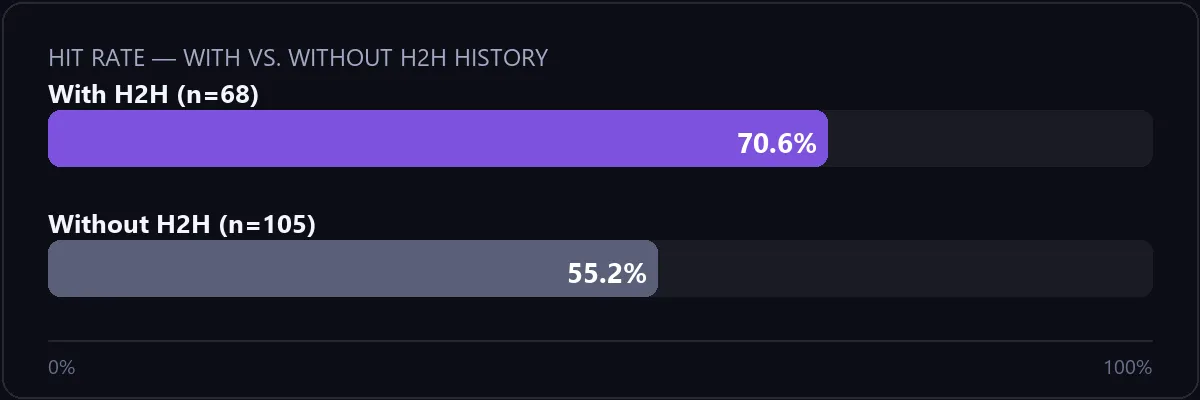
A 15.4-point hit-rate gap, and — importantly — confirmed independently by the CLV column, which doesn’t depend on who won. That combination is a meaningfully stronger signal than either number alone would be.
We’re stating that carefully on purpose. The finding was identified after the fact, from data that wasn’t collected to test this specific question — which means it needs a wide confidence margin and shouldn’t be treated as settled. It’s also not fully explained by the confounders above (the gap held even restricted to non-qualifier matches). We’re watching this, not acting on it as a standalone filter — because when we tested filtering out picks without head-to-head history, it made results worse in units, not better, since the lowest-edge, no-H2H picks turned out to be some of the most profitable in the sample. This is exactly the kind of result that punishes an overly literal reaction.
The practical takeaway
Treat head-to-head the way you’d treat a small extra data point, not a verdict. It’s one input among several — surface-specific Elo, recent form, fatigue — not a trump card that overrides them. If a head-to-head record is the only thing pointing toward an outcome, that’s a sign to look for more evidence, not to bet with confidence.
Frequently asked questions
- Is head-to-head record completely useless in tennis betting?
- No — it's weak evidence on its own, mostly because sample sizes (typically 2-6 matches) are too small to support confident conclusions. It becomes more informative when it isn't the only signal pointing the same direction.
- Why does head-to-head record often mislead?
- It's frequently confounded by surface concentration, the timing of when the matches were played relative to each player's career trajectory, and the ranking gap at the time — none of which is a genuine head-to-head effect independent of those factors.
- Did ServedBets find that head-to-head predicts anything?
- A measured gap showed up in our own tracked picks — with-H2H picks outperformed no-H2H picks on both hit rate and closing line value — but we treat it as a post-hoc, unconfirmed finding with a wide margin of error, not a standalone filter. Filtering on it directly made results worse, not better.
- Should I ever use head-to-head to make a betting decision?
- Only as one input among several, alongside surface-specific ratings, recent form, and the market price — never as the deciding factor on its own.