
tennis
What Is Value Betting in Tennis? A Data-Based Explanation
Value betting is simple to define and hard to do consistently: you bet when your estimate of an outcome’s true probability is higher than what the odds imply. The definition takes a sentence. Getting the estimate right is the entire game.
The two numbers that matter
Every bet has two probabilities attached to it, and value betting is about comparing them.
Implied probability comes from the odds. At decimal odds of 1.95, the
market is pricing that outcome at roughly 51.3% (1 ÷ 1.95). This isn’t a
prediction the bookmaker necessarily believes — it’s the price, adjusted for
their margin (see vig in the glossary).
Your estimated probability is what you think will actually happen, based on whatever information you have — recent form, surface, head-to-head, injury news, or a model.
The gap between the two is your edge. If you estimate 58% and the market implies 51.3%, your edge is +6.7 percentage points. Positive edge is the entire definition of a value bet. You can check this instantly with our value calculator.
Why this is harder in practice than on paper
The formula is trivial. The hard part is the “your estimated probability” half of it, and there are two ways it usually goes wrong.
Anchoring. If you look at the odds before forming your own opinion, your estimate quietly drifts toward the market price — even when you’re consciously trying not to let that happen. This is well documented in decision-making research, not specific to betting. It’s also the reason our own model does blind estimation: the probability is generated before the odds are shown, not adjusted afterward.
Overconfidence in small samples. A player being 3-0 in a head-to-head feels meaningful. Three matches is not a sample size that should move a probability estimate much on its own — recency and narrative are persuasive, and persuasive isn’t the same as predictive.
What tennis-specific factors actually move the number
Not everything that sounds relevant moves a probability estimate by very much. Based on what we’ve measured against real match outcomes:
- Surface matters a lot. A player’s hard-court and clay-court levels can differ by a wide margin — treating “form” as one number instead of one per surface throws away real signal. See surface Elo.
- Recent match load matters, but is easy to overweight. Fatigue is real, but a single loss after a long tournament run is often just as explainable by opponent quality.
- Head-to-head is weaker evidence than it looks, unless the sample size is genuinely large — most H2H records between two players are 2 to 5 matches, which is closer to noise than signal on its own.
Value doesn’t mean the bet wins
This is the part that’s easy to say and hard to internalize: a positive-edge bet is a good decision at the time you make it, independent of the result. Tennis has enough variance that a well-priced favorite loses a real, regular share of the time. The way to check whether your process is actually finding value — as opposed to just getting lucky or unlucky — is to track closing line value across many bets, not to judge any single result.
That’s also why we publish our full pick history, wins and losses both, on the results page instead of only the wins. A record with no losses in it isn’t evidence of skill — it’s evidence that something isn’t being shown to you.
A worked example, start to finish
Say a WTA hard-court match is priced at 1.85 for Player A. Implied
probability: 1 ÷ 1.85 = 54.1%. Your own estimate, built from surface-
specific Elo and recent form rather than gut feel, comes out at 60%. Edge:
60 − 54.1 = +5.9 percentage points.
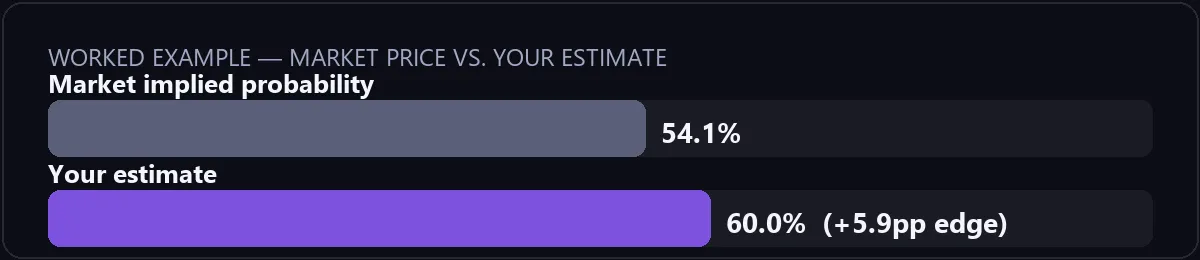
That’s a real, if modest, value bet — not because 60% is a confident prediction (it isn’t; a 60% favorite still loses 2 times in 5), but because the price is better than your estimate says it should be. Run the same two numbers through the Kelly & Value Calculator and it converts that edge into a suggested stake directly, instead of you doing the arithmetic by hand each time.
Now change one input: suppose your estimate is actually 56%, not 60% — a 4-point overestimate, easy to make if a recent narrative (a big win last week) nudged your gut above what the data supports. Edge drops to +1.9pp. Still technically positive, but thin enough that normal estimation error could put the true edge at zero or negative. This is why the estimate, not the formula, is where value betting actually lives or dies — see the section above on where it goes wrong.
Try it yourself
The Kelly & Value Calculator takes your own probability estimate and the odds on offer, and gives you the implied probability, your edge, and a suggested stake size in one step. It doesn’t know anything about tennis — it just does the math cleanly, which is half the battle.
If you want to see this applied live rather than in the abstract, our Discord posts the model’s probability estimate and edge for every pick before the match starts.
Frequently asked questions
- What does "edge" mean in value betting?
- The gap between your own estimated probability of an outcome and what the betting odds imply. A positive edge — your estimate higher than the market's implied probability — is the entire definition of a value bet.
- Why is estimating probability the hard part of value betting?
- Because of anchoring (your estimate quietly drifts toward the market price once you've seen the odds) and overconfidence in small samples (like reading too much into a 3-0 head-to-head record). Both are well-documented failure modes, not specific to betting.
- Does a value bet always win?
- No — a positive-edge bet is a good decision at the time it's made, independent of the outcome. Tennis has enough variance that even a well-priced favorite loses a regular share of the time.
- How do you check whether a betting process is actually finding value?
- Track closing line value across many bets rather than judging any single result — it's the number in this system least affected by short-term luck.