
methodology
How to Calculate Implied Probability From Betting Odds
Implied probability is the single most useful number in betting, and it takes one line of math to calculate. The nuance isn’t in the formula — it’s in what the number does and doesn’t tell you.
The formula
For decimal odds, implied probability is:
implied probability = 1 ÷ decimal oddsOdds of 1.95 → 1 ÷ 1.95 = 0.513 → 51.3%. Odds of 3.50 → 1 ÷ 3.50 = 0.286 → 28.6%. Lower odds imply a higher probability — the favorite
always has the shorter price.
For American (moneyline) odds, the formula depends on the sign:
Negative odds (e.g. -150): implied probability = 150 ÷ (150 + 100) = 60.0%
Positive odds (e.g. +150): implied probability = 100 ÷ (150 + 100) = 40.0%
For fractional odds (e.g. 19/20): treat it as denominator ÷ (numerator + denominator) → 20 ÷ (19 + 20) = 51.3% — the same number as 1.95 decimal,
because they’re the same price in a different format.
You don’t need to do this by hand every time — our odds converter converts between all three formats and shows the implied probability instantly.
Why two implied probabilities add up to more than 100%
Take a two-way market — say, a tennis match with odds of 1.95 on each player. Both sides imply 51.3%, and 51.3 + 51.3 = 102.6%, not 100%.
That extra 2.6 percentage points is the bookmaker’s margin, usually called the vig. It’s not an error — it’s built in deliberately, on every market, by every bookmaker. A “fair” or “no-vig” probability removes it proportionally:
fair probability (side A) = implied A ÷ (implied A + implied B)With two sides at 51.3% each: 51.3 ÷ (51.3 + 51.3) = 50.0% on both sides —
which makes sense, since a coin-flip match priced with margin still implies
50/50 once the margin is stripped out.
What implied probability actually tells you
It tells you what the market is pricing, not what will happen. A 70% implied favorite still loses roughly 3 times in 10 over a large enough sample — if they didn’t, the odds would move. Implied probability is a starting point for comparison, not a forecast on its own.
The comparison that matters is implied probability versus your own estimate. If your estimate is higher, you have edge — the basis of value betting. If your estimate is lower or the same, the price isn’t offering you anything the market hasn’t already priced in.
Where this goes wrong
Two mistakes come up often enough to name directly:
Confusing implied probability with “should win.” A 60% implied favorite is more likely to win than not — it is not a strong favorite in any absolute sense, and treating it as a near-lock misreads the number.
Ignoring the margin when comparing across bookmakers. Two books offering “the same” market can carry different vig, so comparing raw implied probabilities across bookmakers without adjusting for margin can make one look better than it actually is. Compare no-vig probabilities when you’re line-shopping, not raw ones.
Why the margin varies by market
The vig isn’t a fixed number — it varies by market type, and knowing why helps you spot where it’s worth being more careful. A two-outcome market (most tennis moneylines) typically carries a tighter margin than a market with many outcomes (like set betting, where there are four or six possible exact scorelines), because a bookmaker’s risk of getting badly exposed on one side is lower with fewer outcomes to balance. In practice, that means implied probability on a moneyline is usually closer to “fair” than implied probability on a longer-odds, many-outcome market — worth remembering before treating every posted price as equally trustworthy.
Quick reference
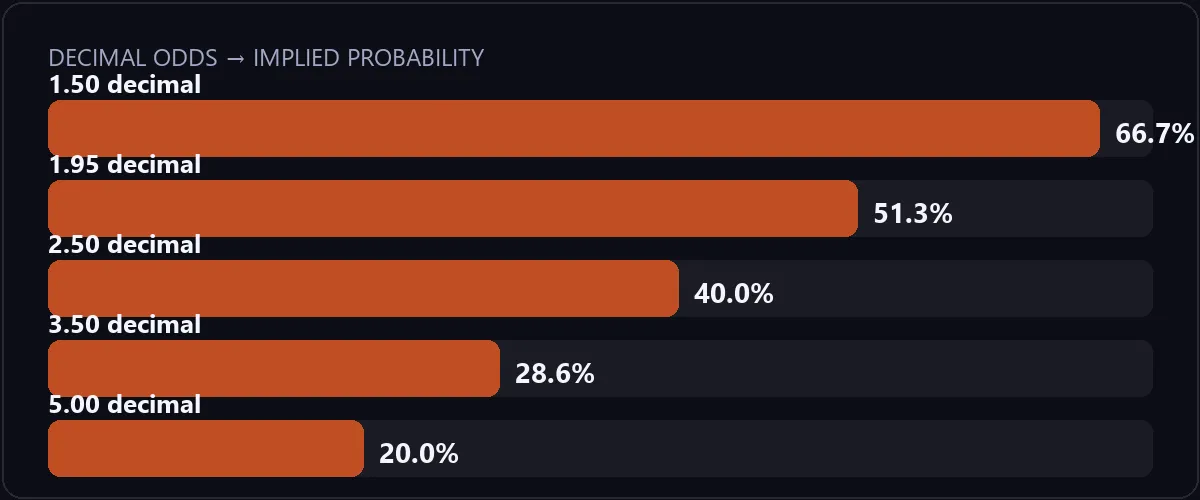
| Decimal | Implied probability |
|---|---|
| 1.50 | 66.7% |
| 1.95 | 51.3% |
| 2.50 | 40.0% |
| 3.50 | 28.6% |
| 5.00 | 20.0% |
For the full picture — edge, Kelly stake sizing, and how we use this in our own model — see what value betting actually means and the glossary.
Frequently asked questions
- Why do implied probabilities of both sides of a bet add up to more than 100%?
- Because bookmaker odds include a built-in margin (the vig). Stripping that margin out proportionally gives the "fair" or "no-vig" probability, which is what should actually sum to 100%.
- Is a 60% implied favorite a safe bet?
- No — implied probability describes what the market is pricing, not a guarantee. A 60% favorite still loses about 4 times in 10 over a large enough sample.
- Does the bookmaker margin stay the same across every market?
- No. Two-outcome markets like most tennis moneylines typically carry a tighter margin than markets with many possible outcomes, like set betting, because the bookmaker's exposure risk is lower with fewer outcomes to balance.
- What's the fastest way to convert odds to implied probability?
- Divide 1 by the decimal odds. For American or fractional odds, the odds converter tool does the conversion and shows implied probability instantly.