
methodology
Is Value Betting Actually Profitable? An Honest Answer
Search this question and you’ll mostly find two kinds of answers: “yes, obviously, buy my picks” and “no, the house always wins.” Neither is honest. The real answer is more specific and less satisfying.
The honest starting point
Bookmaker odds are set by people whose entire job is pricing markets accurately, adjusted with a built-in margin (vig), and continuously corrected by sharp money moving the line. Beating that consistently is hard by design — if it were easy, the market wouldn’t stay mispriced long enough for it to matter.
That’s not a reason to give up on the idea. It’s a reason to distrust any answer that doesn’t sound like it respects how hard the problem actually is.
What “profitable” needs to survive
A single winning stretch proves very little. Tennis has enough variance that a genuinely bad process can look profitable over 20-30 bets by chance, and a genuinely good one can look unprofitable over the same span. The question that actually matters is whether a result holds up once you check it against the two things that separate signal from luck:
Sample size. Our own testing on 234+ tracked picks still comes with real uncertainty bands on most claims — smaller samples deserve wider skepticism, not less.
An outcome-independent check. This is why we lead with closing line value rather than win rate or ROI. A positive result that’s also confirmed by beating the closing line independently is a much stronger claim than a positive result on its own — the two can and do diverge.
What we can honestly say about our own numbers
Our tracked results currently show a positive result in raw units, with positive average closing line value across the picks where CLV is measured. We report both the mean and the confidence interval, not just the headline number — see the current figures on results. At current sample sizes, some individual claims (like specific segment splits) don’t clear statistical significance yet, and we say so rather than rounding up.
What would make us change our answer
If a genuinely large, well-measured sample showed our CLV confidence interval crossing zero, or our real staking results reversing over a longer period, that would be evidence the process isn’t working — and the honest response would be to say so, not to quietly change what gets published. “Not enough data yet” is a valid answer we’re willing to give, and have given, on more than one specific claim.
How to evaluate any profitability claim, not just ours
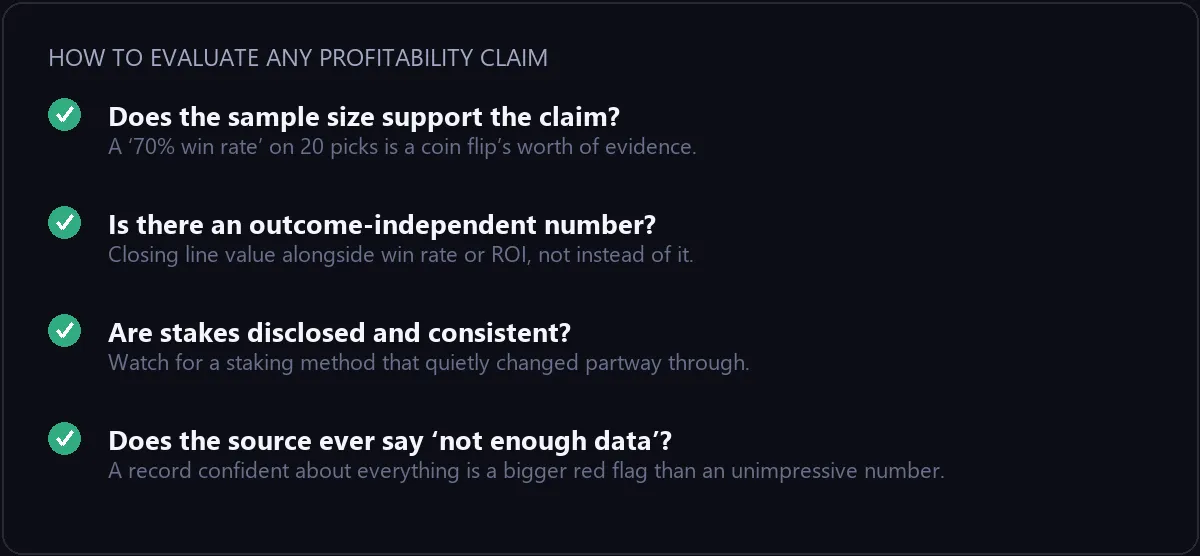
Since the honest answer depends entirely on measurement, here’s what separates a real claim from marketing, whoever is making it:
- Does the sample size support the claim? A “70% win rate” on 20 picks is a coin flip’s worth of evidence dressed up as a track record.
- Is there an outcome-independent number alongside win rate or ROI? Closing line value is the standard one — see why we publish our losses for what a fabricated or cherry-picked record usually looks like in practice.
- Are stakes disclosed and consistent? A record that quietly changed its staking method partway through, or reports ROI without stating flat vs. variable stakes, is much easier to make look better than it is.
- Does the source say “not enough data” about anything? A track record that’s confident about every single claim, with no acknowledged uncertainty anywhere, is a bigger red flag than an unimpressive number.
The realistic takeaway
Value betting can be profitable. It requires beating a genuinely efficient market, which requires either real information or modeling edge the market hasn’t priced in yet, checked against evidence that doesn’t depend on short-term results. Anyone claiming certainty in either direction — always profitable, or never possible — is skipping the part where you actually have to measure it.
Frequently asked questions
- Can you actually make money value betting on tennis?
- It's possible, but bookmaker odds are set by professionals and continuously corrected by sharp money, so beating them consistently is genuinely hard. Any claim of easy, guaranteed profit should be treated with skepticism.
- How much data do you need to know if a betting strategy is actually working?
- Enough that the confidence interval around the result excludes zero. A winning stretch over 20-30 bets proves very little on its own — tennis has enough variance that a bad process can look profitable by chance over that span, and a good one can look unprofitable.
- What's the best way to check if someone's profitability claim is real?
- Look for sample size that supports the claim, an outcome-independent metric like closing line value alongside win rate or ROI, consistently disclosed stakes, and an honest acknowledgment of uncertainty. A source that's confident about every single number is a bigger red flag than an unimpressive one.
- What would make ServedBets say value betting isn't working for its own model?
- If a large, well-measured sample showed the closing-line-value confidence interval crossing zero, or real staking results reversing over a longer period — and that would get published, not quietly changed.