
methodology
Why We Publish Every Losing Pick, Not Just the Wins
If you’ve spent any time around sports betting content, you’ve seen the pattern: an account with a feed of nothing but green checkmarks and win screenshots. It’s the single most common signature of a fake or cherry-picked track record, precisely because it’s the cheapest thing to fake.
Why a win-only feed is worthless as evidence
A win screenshot costs nothing to produce and nothing to fabricate. Anyone can post a bet slip after the fact, or quietly delete the losses before anyone notices. A feed with zero visible losses isn’t evidence of skill — structurally, it’s indistinguishable from an account that simply doesn’t show you the losses.
This is why our own house rule is specific: never post a win without a loss being visible from the same stretch of results. Not because losses are good — because a record that can’t produce a loss isn’t a real record, it’s marketing.
What we publish instead
Every settled pick shows up on the results page — wins and losses both, generated directly from the same tracking database, not curated after the fact. A lost pick that still beat the closing line gets its own card, with the actual number, not a vague “unlucky one.”
The credibility metric we lead with isn’t win rate — it’s closing line value, specifically because it’s the one number in this whole system that doesn’t care whether a given pick won. A liar can fake a win rate by hiding losses. Faking a consistent CLV edge would require actually having a real pricing edge in the first place — there’s no shortcut.
What we don’t publish, and why
Upcoming, unsettled picks stay Discord-exclusive. That’s a business decision, not a transparency one — the free public site shows what already happened; the community sees what’s about to happen. We’re explicit about which is which so it isn’t confused with hiding bad outcomes.
What this looks like when it isn’t going well
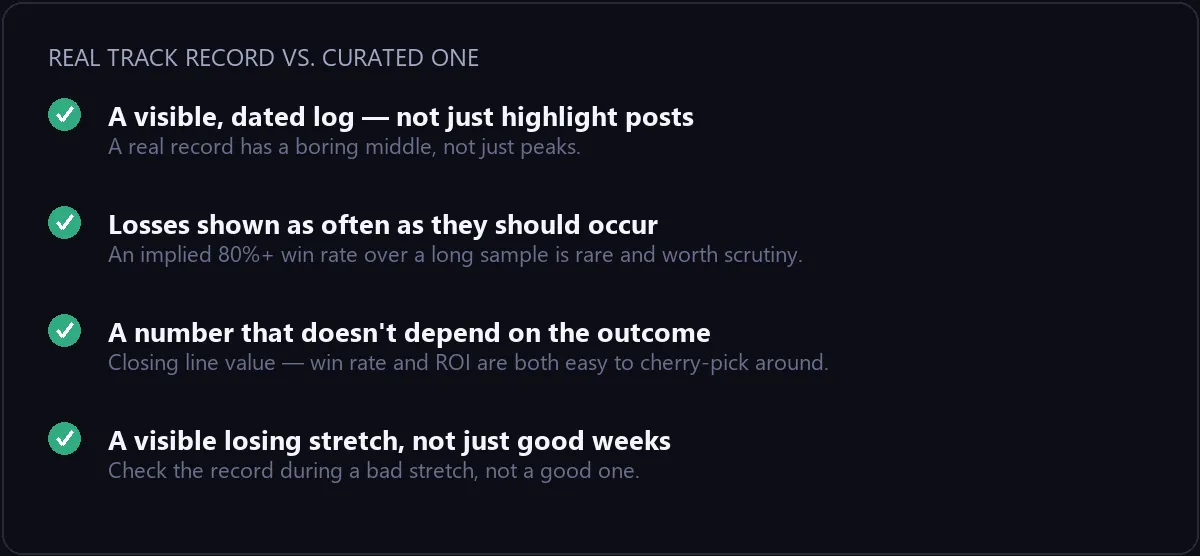
The easiest way to check whether a “we show everything” claim is real: look at it during a bad stretch, not a good one. Check the results page — if the most recent week shown there is a losing one, that’s the policy actually being applied under pressure, not just when it’s flattering. A results feed that only stays public while the numbers look good isn’t really public.
What to check on any track record, including ours
If you’re evaluating any account’s results, not just ours, here’s what separates a real record from a curated one:
- Is there a visible, dated log, not just highlight posts? A real record has a boring middle, not just peaks.
- Are losses shown as often as they should statistically occur? If a feed implies an 80%+ win rate over a long sample, that alone is worth scrutinizing — it’s a rare number in an efficient market.
- Is there a number that doesn’t depend on the outcome, like closing line value? If the only metric offered is win rate or ROI, both are fully dependent on results and much easier to cherry-pick around.
- Does the sample size support the claim being made? See our note on why small samples mislead for more on this.
None of this is a guarantee — a sufficiently patient bad actor can fake almost any single signal given enough effort. But a record with visible losses, an outcome-independent metric, and a real dated history is a lot more expensive to fake than a screenshot folder, and that cost is the actual point.
Frequently asked questions
- Why do so many betting tipsters only show winning picks?
- Because a win screenshot costs nothing to fabricate or cherry-pick after the fact, and a feed with zero visible losses is structurally indistinguishable from one that simply hides them — it's the cheapest, most common pattern among fake track records.
- What's the ServedBets policy on publishing results?
- Every settled pick appears on the results page, wins and losses both, generated directly from the same tracking database — never curated after the fact. The house rule is explicit: never post a win without a loss being visible from the same stretch.
- Why lead with closing line value instead of win rate?
- Because it's the one number in the system that doesn't depend on whether a given pick won, which makes it much harder to fake than a win rate — faking it consistently would require an actual pricing edge.
- How can I tell if a results feed is genuinely showing everything, including bad stretches?
- Check it during a losing week, not a winning one. If the most recent results shown are a losing stretch, that's the "publish everything" policy actually being applied under pressure.