
tennis
Tennis Betting Odds for Beginners: A Plain-Language Guide
If tennis betting content assumes you already know what “implied probability” and “closing line” mean, it’s written for the wrong audience. This one starts from zero.
Reading a single number: decimal odds
Most of the world (outside the US) quotes tennis odds as decimal numbers like 1.65 or 3.20. The number tells you your total payout per unit staked, stake included. Bet 10 at odds of 1.65, and a win returns 16.50 — your 10 back plus 6.50 profit.
The lower the number, the shorter the odds, and the more strongly the market favors that outcome. 1.20 is a heavy favorite. 5.00 is a big underdog. If you want the exact probability that number implies, see our implied probability guide or just use the odds converter directly.
The main markets in tennis
Moneyline / match winner — who wins the match. The simplest and most common market.
Total games (over/under) — will the total number of games played in the match go over or under a set line, e.g. “over 21.5 games.”
Set betting — the exact scoreline, like 2-0 or 2-1 in a best-of-three.
Spreads / handicaps — one player gets a game-count “head start” applied before the result counts.
Moneyline is the easiest to reason about and where most beginners should start — the other markets add extra layers of variance that are worth understanding before betting them.
Favorite vs. underdog isn’t the whole story
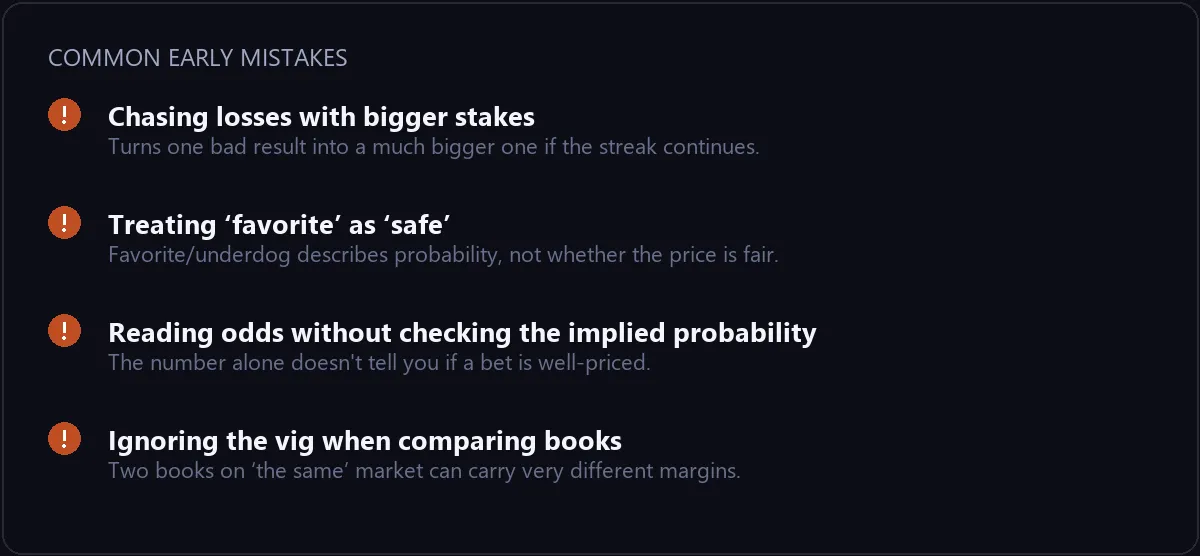
A common beginner mistake is treating “favorite” as “safe” and “underdog” as “risky, avoid.” Both labels only describe relative probability, not whether a bet is well-priced. A heavy favorite at very short odds can be a bad bet if the market has overpriced how likely they are to win. A big underdog can be a genuinely good bet if their real chances are higher than the long odds suggest. This is the entire idea behind value betting — the label “favorite” or “underdog” tells you nothing about whether the price is fair.
Surface matters more in tennis than most sports
Tennis is played on hard, clay, and grass courts, and player performance can swing significantly by surface — see our note on why ratings need to be surface-specific. A player’s overall record can be misleading if you don’t know which surface their strong results came from.
A common early mistake: chasing losses
New bettors lose more money to bet sizing habits than to bad picks. The specific pattern worth naming: after a loss, increasing the next stake to “win it back,” turning one bad result into a much bigger one if the streak continues. Tennis has real variance — even a well-priced favorite loses a regular share of the time, and a short losing run says very little about whether your process is working (see how much short samples mislead). Keeping stakes flat and consistent, rather than reactive to the last result, is the single easiest habit that separates a sustainable approach from a short one — see why flat staking tends to win.
Reading a bet slip, start to finish
Put the pieces together on one example: a slip showing “Player A to win —
odds 1.75 — stake 10 — potential return 17.50.” That return already
includes your stake back, so profit on a win is 7.50, not 17.50. The odds
alone tell you the market prices Player A at roughly 57% (1 ÷ 1.75) — see
the implied probability guide
for the exact math. Whether that’s actually a good bet depends entirely on
whether your own estimate of Player A’s chances is higher than that 57%,
not on the odds number by itself.
Vocabulary you’ll actually run into
- Vig / juice — the bookmaker’s built-in margin. See the glossary.
- Line movement — odds shifting between when a match is posted and when it starts, usually reflecting new information or heavy betting on one side.
- Closing line — the final odds right before the match starts. See closing line value.
- Retirement (ret.) — a match ending early due to injury. Betting rules around retirements vary by bookmaker and market — check them before betting live.
Where to go next
Once the vocabulary above is familiar, the value betting explainer and the Kelly & Value Calculator are the natural next steps — that’s where the actual decision-making happens.
Frequently asked questions
- What do tennis betting odds like 1.65 actually mean?
- Decimal odds show your total payout per unit staked, including your stake back. Odds of 1.65 mean a 10-unit bet returns 16.50 on a win — 6.50 profit plus your original 10.
- Is betting on the favorite always the safer choice?
- No — "favorite" only describes relative probability, not whether a bet is well-priced. A heavy favorite at very short odds can be a bad bet if the market has overpriced their chances, and a big underdog can be a good bet if their real chances exceed what the long odds imply.
- What's the biggest mistake new tennis bettors make?
- Chasing losses — increasing the next stake after a loss to try to win it back, which turns one bad result into a potentially much bigger one. Keeping stakes flat and consistent is the simplest habit that separates a sustainable approach from a short-lived one.
- What tennis betting market should beginners start with?
- Moneyline (picking the match winner) — it's the simplest to reason about. Totals, set betting, and spreads add extra layers of variance worth understanding before betting them.